
Technology developer
Converus: the science behind the EyeDetect lie detector
We administer the tests; the technology is built and refined by Converus (Lehi, Utah, USA) together with a research team from the University of Utah. Here is a short overview of where the method came from, how it was validated, which tests exist and what they run on.
- on the market since 2014
- over 1,000 clients in 60 countries
- tests in over 40 languages, including Ukrainian
- 2002the year the idea of an eye-based test was born
- 12peer-reviewed scientific publications on EyeDetect
- 60+countries where EyeDetect is used
- ≈100,000measurements of each eye during a 30-minute test
How the idea came about
In July 2002, two University of Utah scientists, John Kircher and Doug Hacker, were driving to climb Mount Rainier. Kircher had built the first computerized polygraph with David Raskin in 1991; Hacker studied the psychology of reading. On the way they discussed whether deception could be detected not through breathing and pulse, but through how a person reads and how their eyes behave.
At the foot of the mountain they were joined by Don Krapohl, then a US federal polygraph examiner. He asked the two questions on which every earlier “new lie detector” had failed: is it practical, and is it valid. Practical, yes, because eye-tracking cameras already existed. Validity took more than ten years of laboratory research to prove.
In 2006 the first dissertation showing that the method works was published. In 2012 the key paper, “Lyin' Eyes,” appeared in the Journal of Experimental Psychology: Applied. In 2010 the technology was licensed by the company that later became Converus, and in 2014 EyeDetect entered the market.
A century of lie detection in eight dates
- 1921
John Larson, a medical student and Berkeley police officer, builds the first modern polygraph.
- 1991
Kircher and Raskin of the University of Utah release the first computerized polygraph. It is still in use.
- 2002
Kircher and Hacker formulate the idea: deception shows in involuntary eye behavior during reading.
- 2012
The paper “Lyin' Eyes” in a peer-reviewed journal: the ocular-motor test is recognized as a working method.
- 2014
Converus launches EyeDetect on the global market.
- 2019–2020
The MCT protocol: up to four topics in one test, with an indication of which topic was failed. An audio version for those who cannot read.
- 2021
EyeDetect+: the first automated polygraph combining eye data with body sensors.
- 2023
VerifEye: a 10-minute test from a smartphone, also available in Ukraine.
The Converus science team
Five University of Utah scientists who developed and validated the method.
John Kircher, chief scientist
Over 90 publications on deception detection. Has consulted for the US Department of Defense, the Secret Service, the Department of Homeland Security and Canadian police. Co-creator of the 1991 computerized polygraph.
David Raskin
Over 150 papers and books, including “Credibility Assessment: Scientific Research and Applications” (2014). Has taught at UCLA, the University of Michigan and the University of Utah, and advises governments.
Doug Hacker
Educational psychologist, researcher of reading and writing. Developed a method for studying writing through eye movements, which was later applied to deception detection.
Anne Cook
Cognitive psychologist. Studies memory and attention during reading using eye-tracking, including cognitive load during complex tasks.
Dan Woltz
Studied cognitive abilities for the US Air Force and Stanford. Publications in the Journal of Experimental Psychology and Memory & Cognition.
Don Krapohl, advisor
Former US government polygraph examiner and deputy director of the National Center for Credibility Assessment. Called EyeDetect “the most promising technology in 100 years.”
What the method is based on
Most theories of deception detection agree on one thing: lying is harder than telling the truth. A liar has to suppress the truthful answer, invent another one, keep it consistent and monitor whether they have given themselves away. This is mental work, and it can be measured.
Psychologists have long known that the pupil dilates in proportion to mental load: multiplying 17 by 2 and 17 by 31 produces different reactions. It responds to lying the same way. In studies, people who answered deceptively showed stronger pupil dilation, fewer gaze fixations, less time reading and re-reading the statement, faster responses and less frequent blinking.
The EyeDetect algorithm weighs these measures with logistic regression and produces a credibility score from 1 to 99. The model was trained on mock-crime experiments: some participants actually “stole” something, others merely knew about the event, and the algorithm had to tell them apart.
EyeDetect test protocols
Different formats for different tasks. Our examiner selects the protocol for your situation.
RCT
Two-topic comparison test
A 30-minute screening on two unrelated topics: reactions to one topic serve as the control for the other. Accuracy 86–88%. Suitable for screening job candidates and employees.
DLC
Single-issue diagnostic test
A 15-minute test about a specific event, such as a theft. Compares reactions to the topic with reactions to a “directed lie.” Accuracy 87–90%. For investigations and disputes.
MCT
Multi-topic test
About 28 minutes, up to four topics in one test, and the algorithm indicates which topic was failed. Accuracy 88%. Converus considers it the method's main breakthrough.
Audio MCT
Audio version
Statements are read aloud rather than shown on screen. For people who read poorly or have vision problems. Patented by Converus.
VerifEye 3R / 4R
Smartphone test
Three or four topics plus a comparison topic, questions delivered by voice, answers spoken aloud. About 10 minutes, accuracy 84–89% depending on conditions.
Hybrid
EyeDetect+
Eye data plus body sensors on the wrists and a finger. Accuracy 88–91%. For countries where the law specifically requires a polygraph. Not yet offered by us.
Equipment and data
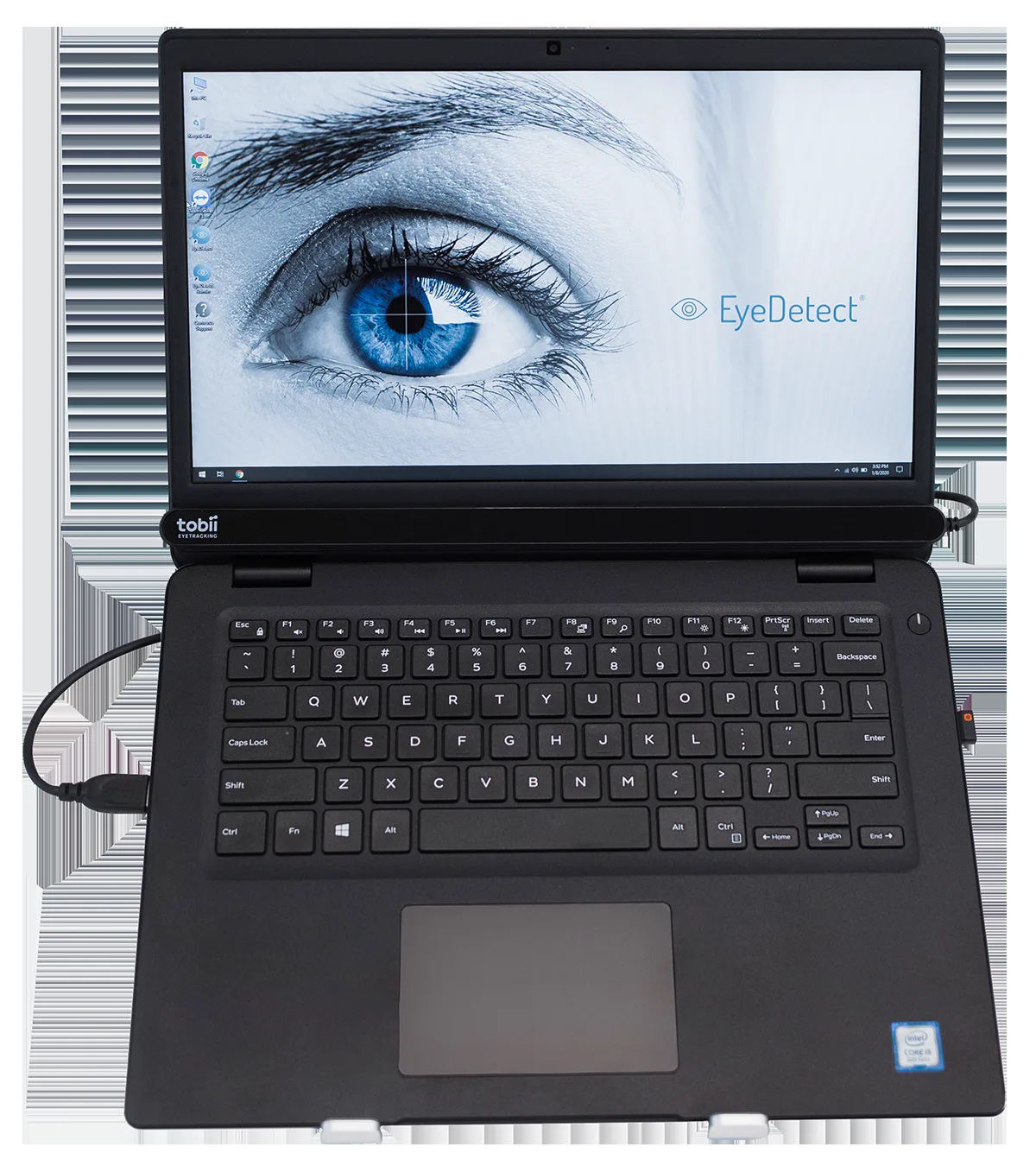
- EyeDetect station: a laptop with dedicated software, an infrared eye-tracking camera and a chin rest.
- The camera takes about 60 measurements of each eye per second: pupil size, gaze position, blinks.
- A 30-minute test accumulates about 100,000 measurements of each eye.
- A Tobii Eye Tracker camera with a special research license: the regular consumer version does not provide this data.
- The station's disk is encrypted (AES-256, FIPS 140-2); data is encrypted with the client's key and deleted from the station after upload to the server.
- The results portal opens only over a secure connection with two-factor authentication.
- Tests are available in over 40 languages, including Ukrainian and Russian.
- Personal data need not be entered: the test is linked to a number, and no photo is taken.
Comparison of methods
Based on the Converus comparison table from April 2025.
| Classic polygraph | EyeDetect | EyeDetect+ | VerifEye | |
|---|---|---|---|---|
| In use since | 1921 | 2014 | 2021 | 2023 |
| What it measures | Breathing, pulse, perspiration: emotional arousal | Eye movements and pupil: mental effort | Eye data plus body sensors | Eye movements and pupil via the phone camera |
| Duration | from 90 minutes to several hours | 15–30 minutes | 20–45 minutes | about 10 minutes |
| Result | score in minutes, report in hours | score and report in under 5 minutes | in under 5 minutes | within a few minutes |
| Accuracy, screening | 85% | 86–88% | 88–91% | 84–89% |
| Accuracy, single issue | 89% | 87–90% | 87–89% | — |
| Body sensors | chest tubes, cuff, electrodes | none | on the wrists and a finger | none |
| Who scores | polygraph examiner, manually | algorithm | algorithm | algorithm |
| Operator training | 10 weeks | about 6 hours plus 2 days for test authors | 4 hours for polygraph examiners | not required for a self-administered test |
Scroll the table sideways →
Converus sources: APA meta-analysis on the polygraph (2011); European Polygraph Journal, 2017; A. Potts dissertation, 2020; Hybrid DLC and Hybrid MCT validation studies, 2021; VerifEye 3R validation, 2024.
Who uses EyeDetect
Over 1,000 clients in 60 countries according to Converus data as of August 2025. Some names are covered by non-disclosure agreements.
Government agencies
State police in Idaho, Utah, Georgia and New Mexico; Connecticut probation services; the Colombian Air Force; the National Bureau of Investigation of the Philippines; UN peacekeepers; federal agencies in Canada, the Czech Republic, Romania, the United Kingdom, Mexico and Peru. Clients also include a government institution in Ukraine.
Business
Samsung (Colombia, Mexico), British American Tobacco (Mexico), Experian (Colombia), Midas (Spain), Terpel, Servientrega, banks in Guatemala. After adopting EyeDetect, Midas rose from fourth to first place in its market.
Lawyers and investigators
Attorneys use the test to assess clients and witnesses; private investigators use it in investigations. In 2018 a court in New Mexico admitted EyeDetect results as evidence for the first time.
Psychologists and therapists
Family counselors use the test in cases of infidelity and addiction: it ends the denial games and speeds up the rebuilding of trust.
Awards and recognition
- 2022: EyeDetect+ won first place at the Utah Innovation Awards in the commercial software category.
- 2021: EyeDetect received the Govies government security award from Security Today.
- 2020: EyeDetect+ named product of the year in the employee screening category.
- 2019: EyeDetect for Investigations won the enterprise software category at the Utah Innovation Awards.
- 2017: finalist, Red Herring Top 100 North America.
- 2018: a Taos County court (New Mexico) admitted EyeDetect results as evidence.
Since 1977, when I began working with deception detection technologies, one of the most important discoveries has been the MCT protocol in EyeDetect. It pinpoints which of several questions a person answered deceptively.
Want to take a test on this technology?
We are a certified Converus partner in Ukraine. EyeDetect in Lviv or on-site (we come to you), VerifEye online from any city.